
Creative Thread-to-Bead Matching
Why Creative Match goes beyond exact color matching - shortlisting thread-to-bead pairs when materials and lighting won’t match a flat catalog code.
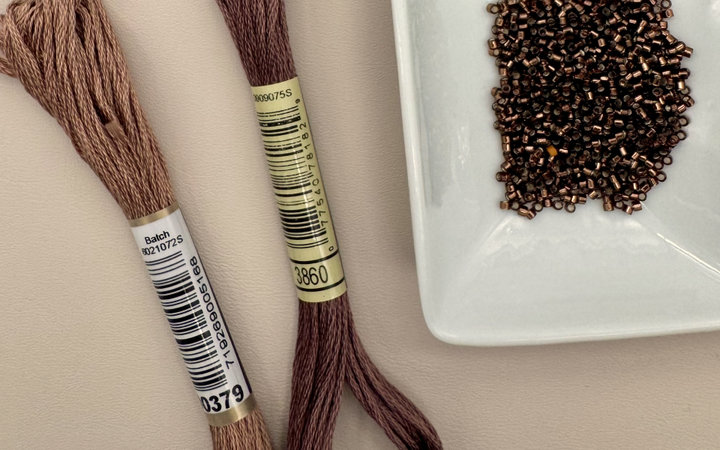
Exact color matching sounds simple until the materials start behaving differently. You usually read embroidery thread as one solid color. A glass bead can carry color in its surface, its core, its coating, and its reflections all at once.
When we started matching Miyuki Delica beads with DMC and Anchor threads, this became one of our biggest problems. It's also why Match & Stitch has Creative Match, a separate result for pairs that work beautifully together even though they aren't exact equivalents.
Why exact matches are not always possible
Miyuki Delica beads come in a huge range of colors and finishes. Some are opaque or matte. Others are transparent, silver-lined, pearlized, glazed, rainbow-coated, or treated with durable surface finishes. Those finishes change how a bead looks as the light and your viewing angle shift.
Thread behaves differently. DMC and Anchor both offer broad, well-organized color ranges, but a strand of cotton can't reproduce every effect that glass, a colored lining, or a reflective coating creates. A bead can look darker at its edge, brighter through its center, or warmer under direct light. One thread can't always capture all of that.
Why forcing an exact match would be misleading
A thread that looks close can still give a different result once it's stitched next to the bead. Calling that pair an exact match would set the wrong expectation, especially if you're buying materials online or planning a detailed palette.
We built Match & Stitch to show clearly how materials relate. If no available thread reproduces a bead closely enough, we'd rather say so than squeeze the pair into the exact-match category.
How Creative Match works
Creative Match starts with your thread and suggests a variety of beads that support its overall character, even when none of them repeats the thread color exactly. The link might be a shared undertone, a balanced contrast, or a finish that brings out one quality of the thread.
You can use a Creative Match to add depth around a focal motif, draw a deliberate outline, soften a transition, or help a reflective bead stand out. How it turns out depends on the rest of your palette, your stitch density, the lighting, and the job each material does in the design. Treat it as an option to test.
A clearer choice for makers
Keeping exact and creative results separate gives you more useful information. Use an exact match when the thread and beads need to read as one continuous color. Use a Creative Match when you care more about harmony, contrast, or emphasis than duplication.
It also respects how materials really behave. Thread and glass can look different and still belong in the same piece, as long as they work together on purpose.
Creative Match is coming soon
We're getting Creative Match ready as part of Match & Stitch, so you can explore more combinations across Miyuki Delica beads and DMC or Anchor threads. Our social pages are new, and they're the best place to see feature updates, matching examples, and launch news.
Follow Match & Stitch on Facebook, Instagram, LinkedIn, Reddit, Pinterest, and YouTube.
Facebook | Instagram | Pinterest | Reddit | YouTube | LinkedIn
Match & Stitch color matching
For thread-to-bead pairings for your next project, see the Anchor to Miyuki Delica Color Matching Catalog in the Ornamentico shop.
Related reading: Why We Built Our Own Thread-to-Bead Color Database
Frequently asked questions
What is Creative Match in Match & Stitch? It suggests a variety of beads that look good with a chosen thread when an exact catalog match isn't possible. Thread and glass have different materials and finishes, and they react to light in ways a flat color code can't show.
Why aren't exact thread-to-bead matches always possible? Threads and beads are made from different materials with different finishes. The same color name can shift under different light, so forcing one exact code would often mislead you.
How should makers use Creative Match? Treat it as a shortlist. Pick the candidates that fit your palette, then check them against the real materials before you commit to a project.