What Do You Call This Color? A Better Way to Search Threads and Beads
Color ideas often begin with a stone, a memory, or a mood, not a product code. Here is why Match & Stitch is adding descriptive search for DMC, Anchor, and Miyuki Delica.
A maker may know exactly which color a project needs yet still lack a useful product code for it. The starting point may be an amethyst stone, a scrap of fabric, a memory, or a simple thought such as "warm gray." A catalog search usually requires something more specific.
That gap is why we developed Search by Poetic Color Name for Match & Stitch. It is designed to help embroiderers and beaders start with ordinary descriptive language, then explore relevant DMC and Anchor threads and Miyuki Delica beads.
When a broad color filter is not enough
Broad filters are useful when the choice is simple. If you need blue, pink, yellow, or beige, they narrow a catalog quickly. They become less helpful when the shade in your head is closer to arctic blue, wheat, cranberry, fire, or dusty green.
The difference matters in material work. A maker may want a blue that feels cold rather than cheerful, a green softened by gray, or a pink quiet enough to sit beside an old textile. Hundreds of results under one basic label do not answer that need. They move the searching work back to the maker.
Starting with the object, not the catalog
The idea became clear while thinking about an amethyst stone. If the stone is the center of a brooch, the first useful search may simply be "amethyst." The maker should not need to translate that idea into several brand catalogs before seeing possible threads and beads.
We have added descriptive tags to the supported materials in the Match & Stitch database. The Search by Poetic Color Name feature uses those tags as an alternative way to access the collection. A search can begin with a material, a temperature, a tone, or an image instead of a known product number.
Where feeling enters the search
Color choices are not always technical. Gifts, memorial pieces, wedding embroidery, and personal objects often begin with the feeling a maker wants the finished work to convey. The source brief includes ideas such as friendship, love, happiness, sadness, and excitement as possible directions for the search.
Those words do not have a single universal color. They are prompts, not rules. Their value lies in opening a path when the maker knows the story before the shade. The results still require the maker's judgment, the surrounding materials, and a check in real light.
A second way into the same database
Product numbers remain useful for precise lookup. Descriptive search serves a different purpose. It is for the person who can picture the color but cannot name the code, or who wants to explore several interpretations before choosing.
Search by Poetic Color Name changes how a search begins. Creative Match, another Match & Stitch feature, addresses a different problem: what to do when two materials can work together without being exact equivalents. Both features leave the final decision to the maker.
What would you call this color?
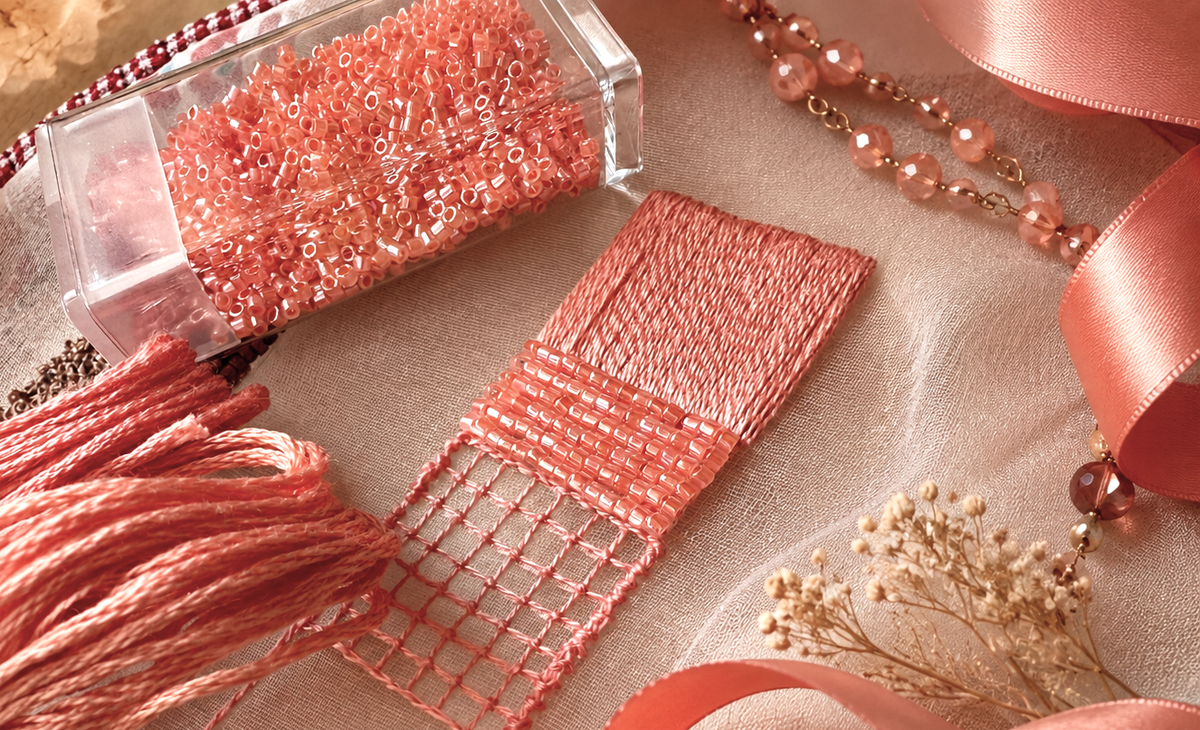
The coral material shown in these photographs serves as a useful test. It could be described as coral, peach, warm pink, salmon, or something more personal. Each word suggests a slightly different expectation.
That is the conversation we want to have as we finish the feature. Look at the thread and beads, ignore the catalog for now, and decide which words you would use first.
P.S. The online tool will be coming soon!
Related reading: Why Creative Match Goes Beyond Exact Color Matching