
From Military Lace to Royal Grace: The Hand & Lock Origins
A personal look at Hand & Lock’s origins, from M. Hand’s military lacework to Stanley Lock’s legacy in couture embroidery.
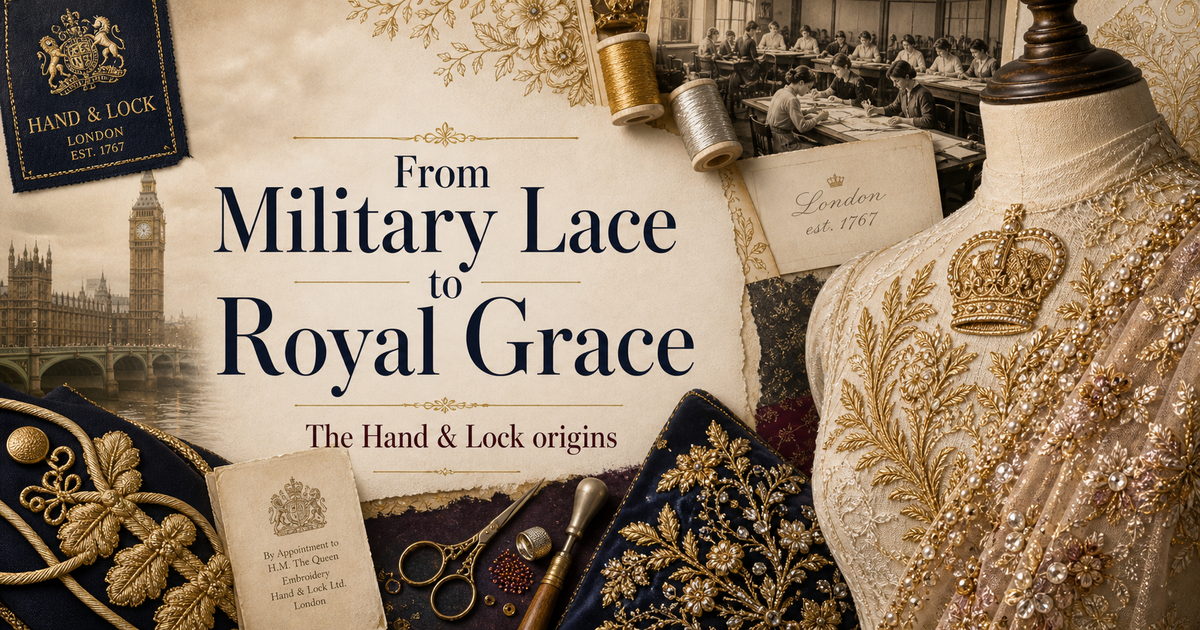
This is the third post in my series on studying couture embroidery.
In the first post, I wrote about what I’m actually studying and why couture embroidery is very different from what many people imagine when they hear the word embroidery.
In the second post, I explained how I chose where to study — and why Hand & Lock became the right school for me.
So now it feels only fair to introduce the school itself.
And honestly, this is where the story becomes a little cinematic.
1767: The Huguenot Refugee
The history of Hand & Lock is actually the story of two very different, but equally prestigious, London embroidery traditions.
It began in 1767, when a young Huguenot refugee from France, known as M. Hand, arrived in London and started selling lace to military tailors. As his reputation grew, his business expanded into military badges and uniform embellishments.
Military embroidery is not just “decoration.” It requires precision, discipline, and highly skilled goldwork — the kind of shimmering detail you see on ceremonial uniforms, badges, and epaulets.
So if you’ve ever admired the intricate details on an officer’s dress uniform, you’ve seen the kind of world M. Hand helped shape.
1898: The Fashion Visionary
More than a century later, in 1898, another embroidery story began in London with C. E. Phipps & Co.
Fast-forward to the 1950s, and a young embroidery designer named Stanley Lock joined the business. When the owner retired in 1956, Lock took over and eventually gave the company his own name.
Lock’s world was very different from the military tradition. It was about fashion, couture, and elegance — but it still required the same discipline, patience, and technical skill.
While Hand’s legacy was built on goldwork for uniforms and ceremonial dress, Lock’s world was shaped by embellishment for beautiful gowns, accessories, and couture pieces.
2001: The Merger
In 2001, these two embroidery traditions came together. Military precision and fashion elegance merged to form the modern Hand & Lock.
Today, Hand & Lock describes itself as Britain’s oldest embroidery atelier, with a history that reaches back to 1767.
No pressure for a student, right? 🤪
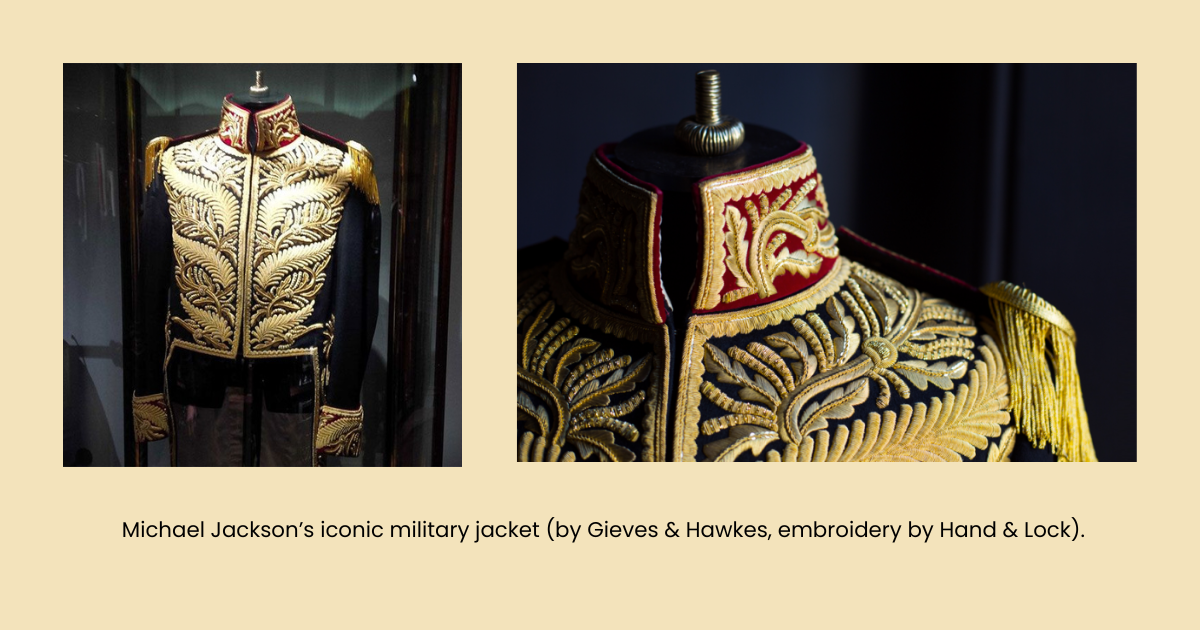
From Michael Jackson to Bridgerton: Embroidery in the Wild
One of the most fascinating things about studying here is realizing that Hand & Lock’s work is not just hidden in archives or museum collections. It is part of our cultural fabric.
Royal history: S. Lock & Co., now part of Hand & Lock, worked on the embroidery for Princess Diana’s wedding veil, which used 139 meters of tulle.
Pop culture icons: M. Hand & Co. provided the goldwork for Michael Jackson’s military-inspired suit by Gieves & Hawkes in 1988.
The Bridgerton effect: If you are a fan of Bridgerton, you may have seen Hand & Lock’s work without realizing it. For the drawing-room embroidery scenes, they used a Victorian-era hand-guided machine to create embroidery pieces. They even produced several versions at different stages of completion, so the characters looked as if they were genuinely making progress throughout the series.
And yes, I now watch films and historical series differently. 🤪
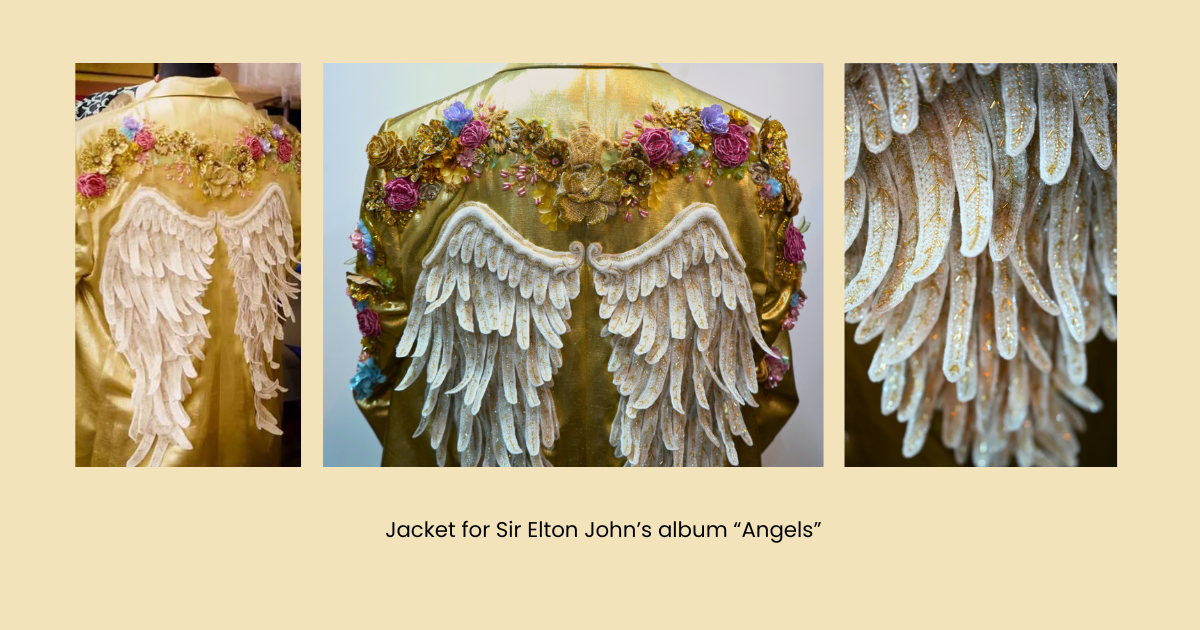
The Serious Rabbit Hole: My Diploma Path
Today, Hand & Lock is a working embroidery atelier that handles everything from restoration to bespoke embroidery, interiors, military work, fashion, and education.
Their Contemporary Embroidery Diploma is built around five core areas, and I am studying all of them:
- Contemporary Goldwork — where traditional military techniques meet modern design
- Haute Couture Fashion — the gold standard of wearable embellishment
- Jewelry & Wearable Art — where my original passion for jewelry connects with thread
- 3D Contemporary Hand Beading — building volume, structure, and dimensional surfaces
- Embroidery & Embellishment for Interiors — bringing couture-level craft into living spaces
The official diploma page lists these five areas as the program's structure.
Why This School Is Important to Me
What I love most is that Hand & Lock does not treat embroidery as a frozen historical artifact.
It treats embroidery as a living language.
A language of thread, wire, beads, fabric, padding, sequins, texture, and structure.
It is not just about making something “pretty.” It is about understanding how a stitch can hold shape, how a surface can tell a story, how an embroidered object can become jewelry, clothing, interior design, costume, ceremony, or art.
I accidentally entered this rabbit hole.
And now, apparently, I am learning how to build worlds inside it.
What’s Next?
Soon I’ll start sharing photos from my actual modules: the techniques, the samples, the mess, and eventually, my approved diploma designs.
It’s about to get a lot more personal.
And probably a lot more chaotic.
If you missed the beginning, you can catch up here: