
Floral Earrings from Organza Embroidered with Beads
Blue floral organza earrings with bead embroidery - a step-by-step tutorial for handmade statement earrings from fabric petals to hooks.
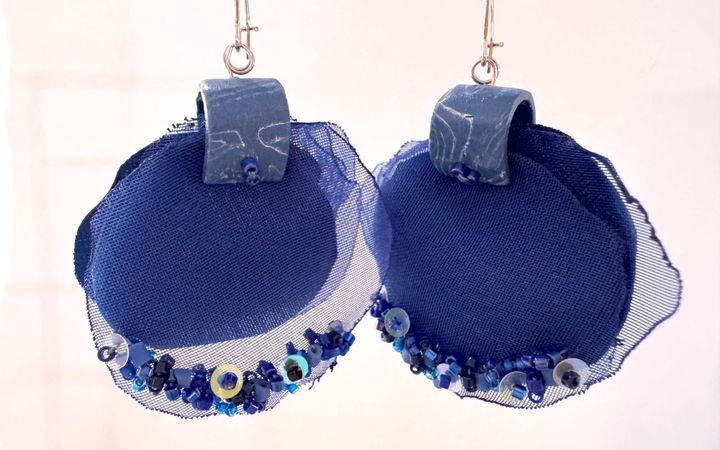
Today I'm going to share how I make these lovely, bright floral earrings from organza fabric. They have organza petals embroidered with beads and sequins, mixed with plain organza and polyester petals. I burn the edges of all the petals so they don't fray. Then I finish the earrings with a handmade polymer clay element connected to an earring hook.
We have similar earrings in our online store if you'd like to buy a pair. There's also a detailed tutorial for those earrings on our YouTube channel, if you prefer watching to reading. The earrings in today's post are slightly different from the original version, because I decided to decorate them with bead and sequin embroidery. Let's start.
Materials and tools
First, here's the list of materials I used to make these blue earrings.
Organza fabric, a piece about 30 x 30 cm. Any color will work. In this tutorial, I'm using deep blue organza. A piece of non-transparent polyester in a matching color. In my fabric floral jewelry, I like to combine different types of fabric to make the flower look natural, but you can use just one fabric too. What matters is that the fabric is 100% synthetic, so the edges of the petals burn well. Make sure your organza piece fits in your embroidery hoop.
Any round shape to mark the petals on the organza. I use round cutters for polymer clay. It's better to have two sizes. Mine are 3.5 cm and 4 cm in diameter. Any round shape will do, as long as your petals are at least 3 cm in diameter (smaller petals are harder to burn).
A mix of matching beads and sequins. I'm using size 11 Toho beads, size 15 Toho beads, size 11 Miyuki Delica beads, sequins and small cylinder beads. You can also use other embroidery stitches (like French knots) or any other type of bead. I wouldn't use stones in these earrings, because they'd make them heavy. That's why I only used the lightest materials I could.
Beading thread in a matching color. A beading needle. An earring hook or stud earring fitting. A pair of embroidery hoops. I have three sizes for embroidery and beading, and I also bought a set of four "legs" for my hoops on AliExpress. They simply clip onto the hoops and let them stand above the table. And they're awesome! You don't have to hold your work in your hands, and it's easier to follow your decoration path. A tea candle. A pair of tweezers. A couple of pliers to attach the earring hook.

Choosing how to finish the earring
Once your flower is shaped, you can decide how to turn it into an earring. There are several options. You can attach the flower to a piece of felt and glue it to a stud earring setting. That's how the earrings in our YouTube tutorial are made. Or you can simply connect the flower to a standard earring hook by stitching a jump ring to the fabric. I decided to experiment with a couple of handmade polymer clay pieces, which you can see in the photo below. Leave a comment if you'd like me to write a post about making these polymer clay elements.

Step 1: Iron the organza and mark the petals
Start by ironing your piece of organza and drawing 2 bigger circles on it. I was making 3 different pairs of earrings at the same time, which is why you'll see 6 marked circles in the photo. Then fix the fabric in the embroidery hoop and start decorating with beads and sequins.

Step 2: Embroider the petals
I do free-form bead embroidery, without a prepared design. I usually stitch 3 or 4 size 11 beads, a sequin with one small bead to hold it, a small bugle bead, and then another 3 or 4 size 11 beads. I use the size 15 beads at the very end to "polish" the edges of the embroidery.
For this project, I also tried something new: I put beads on the back of the work as well as the front, to hide the thread on both sides of the petal. These are dangle earrings, so the petals can be seen from behind, and I wanted the back of the work to look neat too.


I only embroider the bottom edge of each future petal. The embroidery will be visible on the finished earring, but because it's small, it won't make the earring heavy (I prefer light earrings myself).
Here are a couple more photos of the embroidered petals.


Step 3: Cut out the embroidered petals
When you finish embroidering, take the organza out of the hoop and carefully cut out each petal, leaving about 4 to 5 mm of organza around the embroidered part.

Step 4: Cut the remaining petals
Once the embroidered petals are done, mark and cut the rest of the petals you need. For one earring, I used:
- two embroidered organza petals (4 cm in diameter)
- one plain large organza petal (4 cm)
- one plain small organza petal (3.5 cm)
- one large blue polyester petal (4 cm)
- one small blue polyester petal (3.5 cm)
That's six petals for one earring.

If you've never burned fabric edges before, I recommend cutting 2 or 3 extra petals. When I first tried this, I burned a few of them wrong (either I burned them too much or the shape came out ugly). Once all your petals are cut, you're ready for the next step.
Step 5: Burn the edges
Now take the tea candle and a pair of tweezers. Light the candle, hold one petal with the tweezers, and slowly bring the petal close to the flame, keeping about 0.5 cm between the petal and the flame. Don't rush, breathe :) and move slowly. When organza or another synthetic fabric gets close enough to the flame, the edge melts. The melted edge seals the fabric, so it stays whole and doesn't fray. Turn the petal until the whole circle is sealed.


Working safely with an open flame
Please don't forget that you're working with fire! Tie up long hair and always use tweezers. If it's your first time, you can even keep a small bowl of water next to you, so you can put out the flame if a petal starts burning too much.
When all your petals are ready, you can assemble the earrings.

Step 6: Assemble the flower
I put all 6 petals together, mixing big and small ones, with the embroidered petal on top. Then I fix them together at the top center with a few small stitches.


Steps 7 and 8: Prepare the polymer clay element
As I mentioned at the beginning, I used small polymer clay elements for this project. Please leave us a comment if you'd like a post on how to make them.
For the first pair of earrings, I used these small cylinder-shaped elements.

Step 7. I made small holes in each element with my hand drill for tiny drill bits.

After making a hole in the center of the clay element, I also made a hole at each edge.

Step 8. With all three holes made, I inserted a small ball-head pin into the center hole and made a loop on top of the clay element with round pliers.


Step 9: Connect the flower to the clay element
Now the polymer clay elements are ready, and I can connect the fabric flower to them. I used the holes at the edges of the clay shape and passed the needle through them several times. On the front of the beaded element, I added two small Miyuki Delica beads to hold the thread.


Then I repeated steps 6 to 9 to assemble the second earring. Here's the result:

Step 10: Add the earring hooks
Now all that's left is to put the earring hook through the loop of the ball-head pin, and the earrings are ready!

Three variations from the same method
As you saw at the beginning, I had several different shapes made from blue polymer clay, and I used them for a couple of other designs. The second pair is connected the same way: three holes, a ball-head pin and an earring hook.

The third polymer clay element was wider than the other two. To attach the fabric better, I made four holes at the edges and used a stud earring fitting instead of a hook.


Here are all three pairs of earrings I made that day:


We hope you like this experimental crafting project. As always, let your imagination guide you. You can make the earrings the way I did, in one color with accents in similar shades. Or you can go for contrast, with different colors of organza or different colors of beads. Organza and polymer clay are both very lightweight, so even though the earrings are medium-sized, they stay light and flowing.
Please leave us a comment if you have any questions. And let us know if you like this design and want to see more designs that combine fabric and beads. Check out our YouTube channel for more tutorials, and subscribe to this blog to be the first to get our new crafting ideas.
Thank you for reading, and happy crafting!
Related reading: How to Make a 3D-Beaded Ring
Frequently asked questions
Which fabric can I use for the burned petals?
Use 100% synthetic fabric so the edges of the petals melt and seal properly. In this tutorial, I combine deep blue organza with a non-transparent polyester in a matching color, but you can use just one fabric.
How do I stop the organza petals from fraying?
Burn the edges. Hold each petal with tweezers about 0.5 cm from a tea candle flame and move it slowly until the whole edge has melted. Don't cut petals smaller than 3 cm in diameter, because smaller ones are harder to burn.
How many petals does one earring need?
Six: two embroidered organza petals (4 cm), one plain organza petal (4 cm), one plain organza petal (3.5 cm), one polyester petal (4 cm) and one polyester petal (3.5 cm). If you've never burned fabric edges before, cut 2 or 3 extra petals.
Will the bead embroidery make the earrings heavy?
No. The embroidery is only along the bottom edge of each petal, I don't use stones, and both organza and polymer clay are very light, so the earrings stay light and flowing.
Can I make studs instead of hook earrings?
Yes. You can glue the flower onto felt and attach it to a stud earring setting, or do what I did for the third pair: make four holes in a wider polymer clay element and insert a stud earring fitting. If you'd rather buy a finished pair, see our handmade earrings.